Blog ·
Power cuts at a dental clinic: how we protected the entire clinic with a UPS
A dental clinic in Barcelona was suffering power cuts and could not afford to leave a patient mid-treatment. We explain how we sized and installed a 10 kVA online UPS with its battery modules and maintenance bypass so that operating rooms, treatment rooms, dental chairs, lighting, compressor, suction and computers keep running for around two hours without mains power.
In a dental clinic, a power cut is not just an inconvenience. If the power goes off with a patient in the chair, the suction, the compressor, the treatment room lighting and the computers holding the appointment book and patient records all stop at once. The treatment is left half-done and the rest of the day's appointments are up in the air.
That is what was happening to a dental clinic in central Barcelona, which was suffering supply interruptions. Here is how we solved it: an uninterruptible power supply (UPS) that keeps practically the whole clinic running when the mains fails.
The starting point: a joint visit with the manufacturer
The clinic contacted Salicru, a Spanish UPS manufacturer, who recommended us as installers. We carried out a joint visit, their sales engineer and our team, to review the electrical panel, the equipment and the way the clinic works.
That visit produced the requirement that would shape the whole project: being able to keep working for around 120 minutes without power. That is enough time to calmly finish any treatments in progress and, in most outages, for the power to come back without patients even noticing.
From protecting an operating room to protecting the whole clinic
The first proposal focused on the operating room: a 6 kVA UPS and dedicated circuits for the suction, the compressor, the dental chair and the room lighting.
After the visit, the clinic's management wanted to go further and include the general lighting as well. With more loads connected and the 120-minute target, we agreed with the manufacturer to go up one power size to be on the safe side. The final solution protects the entire clinic, not just one room.
The equipment: a 10 kVA online double-conversion UPS
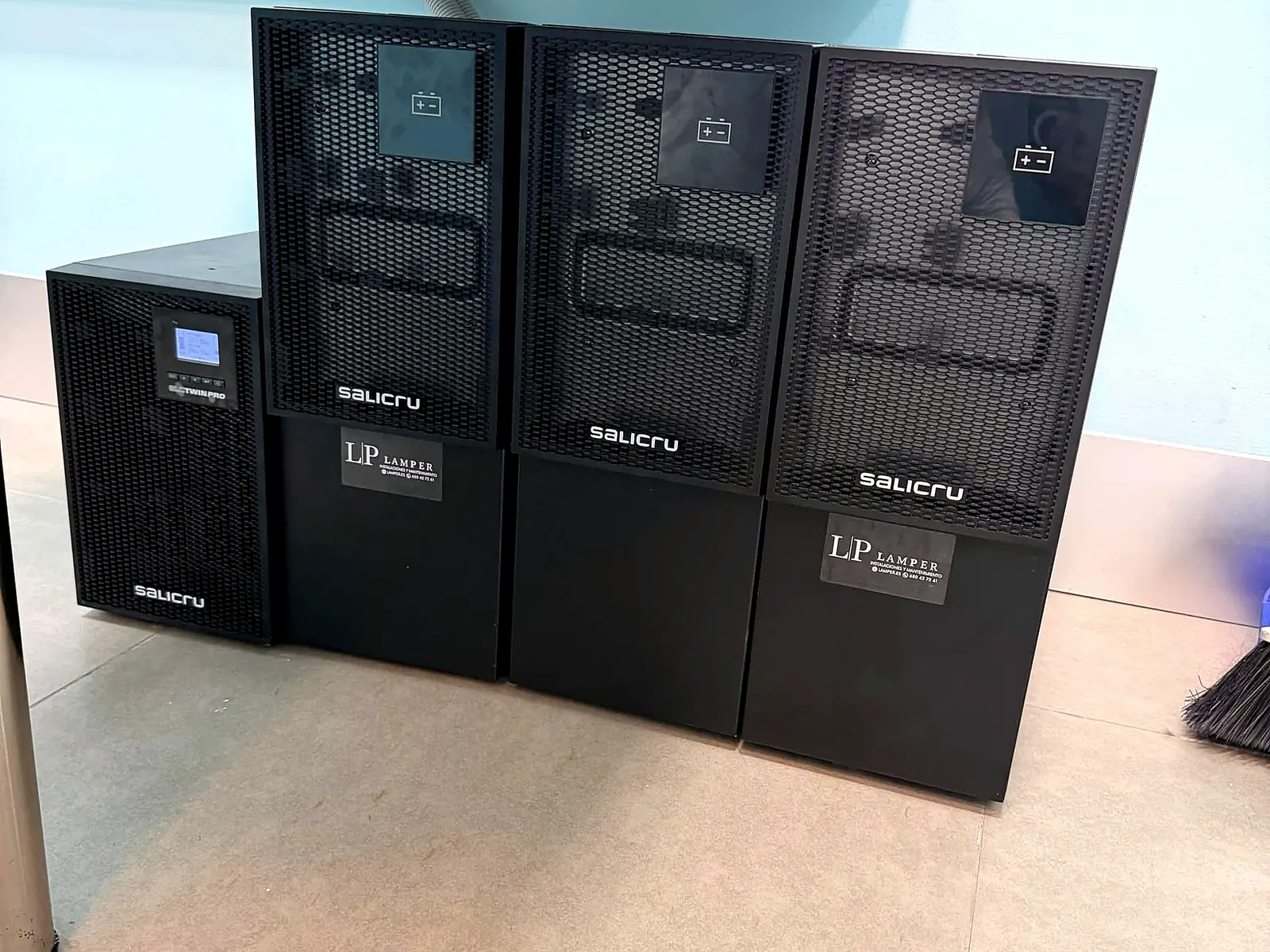
We installed a Salicru SLC-10000-TWIN PRO3 UPS in tower format, with two external battery modules to extend the runtime.
- It is an online double-conversion UPS: the equipment is always powered through the UPS, which rectifies the mains current and regenerates it clean and stable. When the mains fails, it keeps supplying power from the batteries without any interruption, and in the meantime it filters out micro-outages, voltage dips and disturbances.
- It has an output power factor of 1: its 10 kVA are also 10 kW of usable power.
- It includes an LCD display, USB, RS-232 and RJ-45 communications, emergency power off (EPO) and the ability to monitor its status.
The manufacturer quotes a runtime of around 48 minutes at 100 % load and around 65 minutes at 75 %. In this clinic, the actual consumption of the connected equipment is well below the UPS's maximum power, so the expected runtime is around 120 minutes or more.
What stays powered and what doesn't
We reviewed and identified the separate circuits supplying each area of the clinic and connected everything needed to keep the clinic running to the UPS's protected output:
- Operating rooms and dental treatment rooms.
- Dental chairs.
- General lighting of the clinic.
- Air compressor and suction system.
- Staff workstations: reception, computers and office equipment.
- Auxiliary clinical equipment.
Air conditioning was deliberately left out. It is not essential for treating a patient during a power cut, and its high consumption would eat up a large part of the runtime. It is a design decision: every watt not connected to the UPS means extra minutes for what really matters. For the same reason, during a power cut it is advisable not to use any equipment that is not essential.
A UPS panel with a maintenance bypass
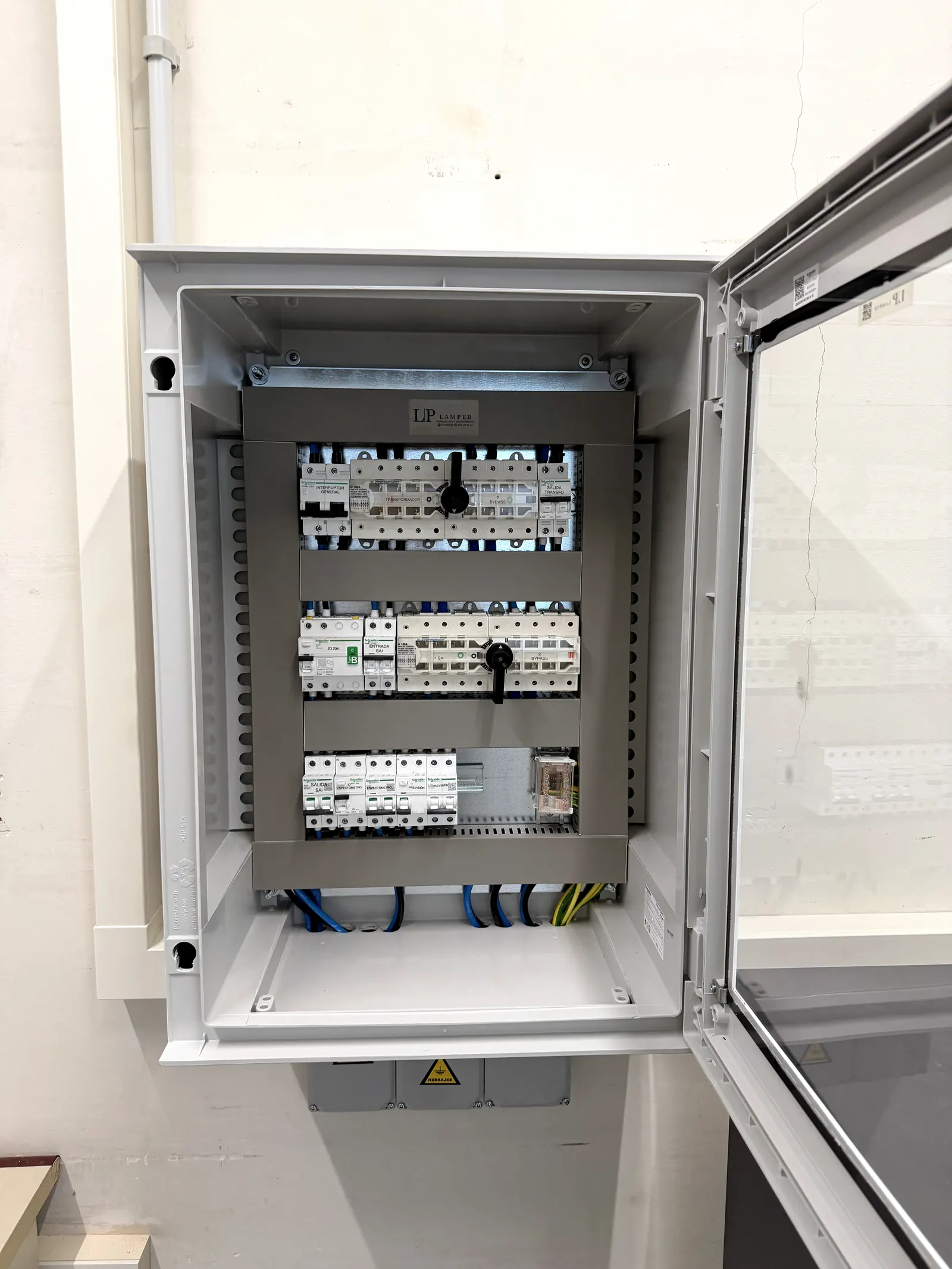
The UPS is not simply plugged in. We fitted a protection and switching panel that protects the input line, the output to the clinic's loads and the bypass line, with every circuit and every terminal labelled.
The maintenance bypass allows the clinic to be switched directly to mains power, in a controlled way, so the UPS can be serviced or replaced without leaving the clinic without power. In an installation that the daily activity depends on, working on a UPS without a bypass would be far more delicate.
How we did it
- Joint visit with the manufacturer to define requirements and power rating.
- Detailed quotation, with every item and its exclusions explained, and adjusted when the clinic decided to extend the scope.
- Ordering the equipment from the manufacturer and planning the works with the clinic, scheduling the most disruptive tasks first thing in the morning so as not to affect patients.
- Positioning the UPS and installing the battery modules and the panel with bypass.
- Adapting the clinic's electrical panel and connecting each circuit to the protected output.
- Continuity testing, verification of the existing protective devices, functional tests on each circuit and commissioning of the system.
What you can apply in your clinic or practice
You don't need a large clinic to need a UPS. If the power goes off from time to time in your dental clinic, practice or healthcare centre, these are the key points:
- Decide what has to keep running and for how long. That time is what determines the size of the UPS and the batteries.
- Size it based on actual consumption and with a margin. The runtime the manufacturer quotes at full load is not the runtime of your installation, and the start-up currents of the compressor and the suction also count.
- For sensitive equipment, an online double-conversion UPS: there is no interruption when switching to batteries.
- Leave out anything that is not essential, such as air conditioning, to gain runtime.
- Plan for the maintenance bypass from the outset.
- Check the UPS and its batteries periodically: batteries age and the runtime decreases over the years.
If you'd like to see more examples, read how we set up UPS-protected power with bypass in businesses. And if the power goes off in your clinic and you'd like us to look into it, get in touch.