Blog ·
Ducted direct expansion or fan coils with an air-to-water heat pump: why the first usually uses less energy
Both systems are heat pumps with a compressor and refrigerant, but they move heat differently. The ducted unit transfers it from the refrigerant straight to the room air; an air-to-water heat pump with fan coils first passes it through a water circuit. We explain why that usually costs energy, with figures from manufacturers' data sheets, and when the air-to-water option is the better fit.
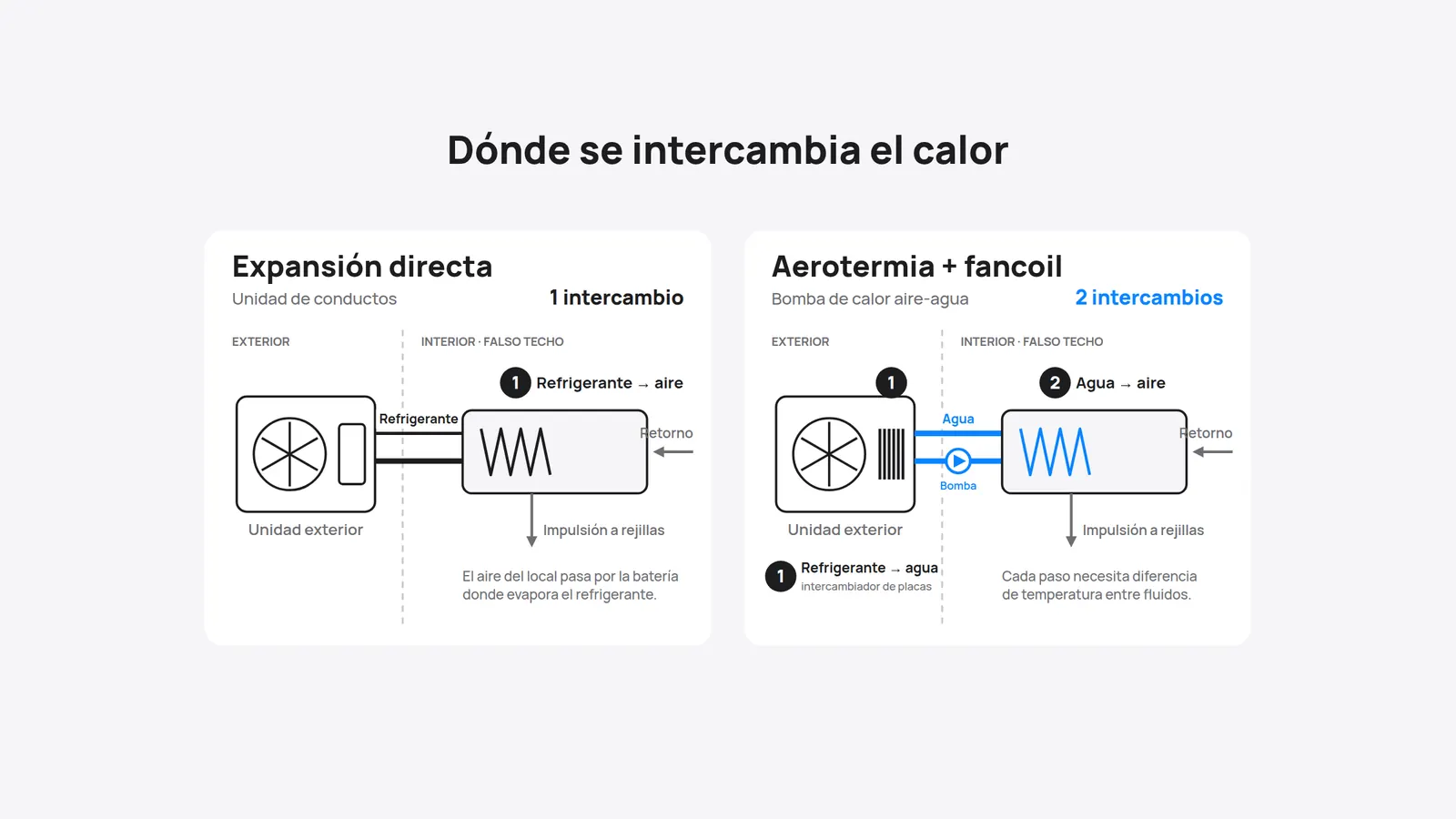
In offices, shops and restaurants there are two common ways to heat and cool through the air with a heat pump. One is the ducted direct expansion (DX) unit: an outdoor unit and a ducted indoor unit in the false ceiling, connected by refrigerant piping, which distributes air through grilles. The other is an air-to-water heat pump that cools or heats water, plus fan coils that pass that cooling or heating to the air in each zone.
Both take energy from the outdoor air. Strictly speaking, the ducted unit is also an air-source heat pump, but in Spain the term «aerotermia» is used for the air-to-water type, and that is what we compare here. What differs between them is the path heat follows inside the building.
One heat exchange or two
Both machines exchange heat with the outdoor air in their outdoor unit. The difference is on the room side.
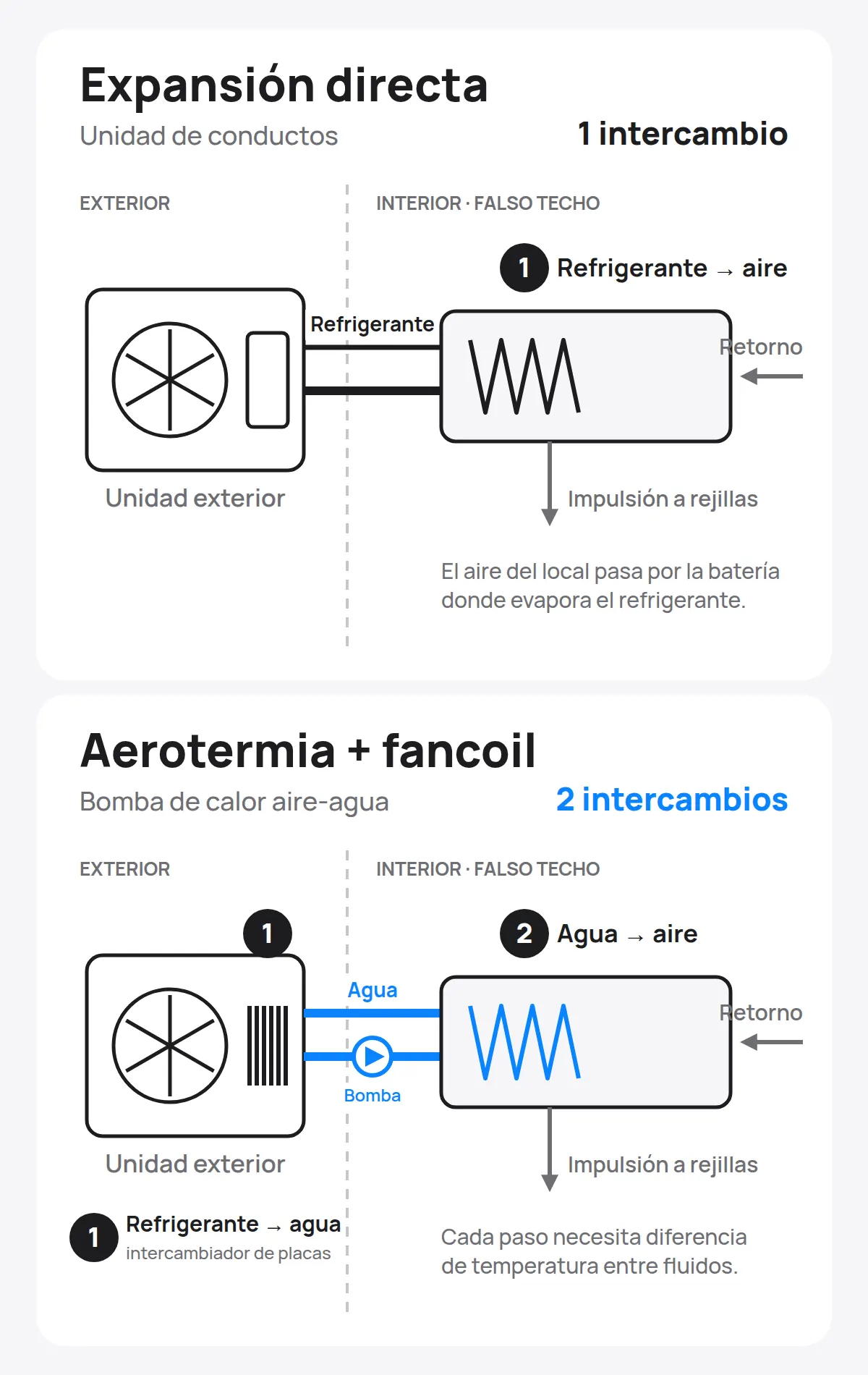
In a direct expansion unit, in cooling mode, the refrigerant evaporates inside the coil of the indoor unit. The room air passes through that coil and gives up its heat. There is a single exchange: refrigerant and air. In heating mode, the refrigerant condenses in that same coil and warms the air.
With an air-to-water heat pump and fan coils there are two. First, the refrigerant cools water in a plate heat exchanger. Then the circulation pump carries that water to each fan coil, and in its coil the air gives up heat to the water.
For heat to pass from one fluid to another there has to be a temperature difference between them. If the fan coils run on 7 °C water, the usual temperature when moisture has to be removed, the refrigerant must evaporate a few degrees below those 7 °C. In direct expansion that extra step does not exist. With comparable coils and airflows, the refrigerant can evaporate somewhat higher and deliver the same service. It has to be checked for each selection, because coil size, airflow and the moisture to be removed also play a part.
In heating the same happens the other way round. If a fan coil needs 45 °C water to cover the load, the refrigerant has to condense above those 45 °C. A fan coil with more coil surface can work with cooler water, which improves the heat pump's performance.
Why a few degrees change consumption
The compressor compresses the refrigerant from evaporating pressure to condensing pressure. The lower the evaporating temperature and the higher the condensing temperature, the larger that lift and the more energy it uses for each kW of cooling or heating it delivers.
The theoretical limit is set by the Carnot cycle. In cooling, the maximum possible efficiency is the evaporating temperature divided by the difference between condensing and evaporating temperatures, in kelvin. A hypothetical example, just to show the effect, with 35 °C outside and the same condensing temperature in both cases, around 45 °C (318 K):
- Direct expansion, evaporating at around 6 °C (279 K): 279 / 39 ≈ 7.2.
- Air-to-water heat pump producing 7 °C water, evaporating at around 2 °C (275 K): 275 / 43 ≈ 6.4.
That is 4 degrees lower evaporation and about 10 % less theoretical efficiency. These temperatures are not measurements from any unit, and no real machine reaches the Carnot limit, so that percentage is not a saving. What holds is the trend: evaporating lower or condensing higher costs energy.
The data sheet of the Daikin Altherma 3 M (EBLA08E) shows it. With 35 °C outside it declares an EER of 3.14 when producing 7 °C water and 5.19 when producing 18 °C water. They are two different operating points of the same machine, but the difference comes mainly from the water temperature.
What the heat pump's EER leaves out
EER and COP are measured to standard EN 14511. For ducted units, the figure includes the indoor unit fan, though only the part that overcomes its internal losses, not the whole duct network. For an air-to-water heat pump, the figure only covers the machine that produces the water. Left out are:
- The fan coil fans. For reference, in Gree's ducted fan coil catalogue, the 5.5 kW cooling model with 30 Pa available pressure draws 102 W.
- The circulation pumps, for the part that moves water through the pipework and fan coils. The standard only attributes to the machine the share that overcomes its internal losses.
- Heat losses from the water pipes and the buffer tank, if there is one. They depend on the routing and the insulation, which the Spanish RITE requires for both systems (IT 1.2.4.2.1). Water pipes are larger: Mitsubishi Electric recommends 26/28 or 30/32 mm copper for the 8.5 kW Ecodan, while the Daikin FBA71A ducted unit connects with 9.5 and 15.9 mm pipes.
In heating there is a consumption both technologies share but handle differently: defrosting. In cold, damp weather the outdoor coil frosts up and the unit reverses the cycle for a few minutes to melt the ice. In an air-to-water heat pump that heat comes from the water in the system. That is why Mitsubishi Electric sets a minimum of 7 litres of water in the primary circuit for the Ecodan PUZ-WM85VAA, the amount needed for defrosting, and recommends 30 litres to also avoid short cycling. That volume must be available even when zones are closed. A direct expansion unit also defrosts: during that time it stops the indoor fan and stops heating for a few minutes.
Response time
A ducted unit starts the compressor and within a few minutes cool or warm air comes out of the grilles. With an air-to-water heat pump, the water circuit and any buffer tank must first be brought up to temperature. That inertia gives stability and smooths starts and stops. In an office with set hours or a restaurant that opens at a fixed time, it may mean starting earlier. How much that adds to consumption depends on the water volume, the losses and the controls.
The data-sheet figures
These are catalogue examples of around 6-8 kW, as published by each manufacturer. They are not selected for the same load: with 7 °C water, the 8 kW Altherma delivers 5.44 kW of cooling, less than both ducted units.
- Mitsubishi Electric PEAD-M71JA2 ducted unit with SUZ-M71VA outdoor unit (7.1 kW cooling): SEER 6.2, SCOP 4.1 and declared EER of 3.50 with 35 °C outside and 27 °C inside.
- Daikin FBA71A ducted unit with RZAG71M outdoor unit (6.8 kW nominal cooling): SEER 6.22, SCOP 4.20, nominal EER 3.66 and nominal COP 4.47.
- Daikin Altherma 3 M air-to-water heat pump (EBLA08E), with 35 °C outside: EER 3.14 with 7 °C water and 5.19 with 18 °C water. In heating, with 7 °C outside: COP 4.60 with 35 °C water and 3.50 at 55 °C. SCOP 4.61 at 35 °C and 3.35 at 55 °C.
- Mitsubishi Electric Ecodan PUZ-WM85VAA air-to-water heat pump with ERPX-VM6D hydrobox: EER 4.90 with 18 °C water and 35 °C outside; SCOP 5.00 at 35 °C and 3.60 at 55 °C.
A partial example for cooling: the Altherma draws 1.73 kW to deliver 5.44 kW with 7 °C water. Add a fan coil like the one above, about 0.10 kW of fan, and the set comes to 5.44 / 1.83 ≈ 3.0. That still leaves out the circuit pump, pipe losses and the heat the fan itself adds to the air. The Daikin ducted unit declares 3.66 with its indoor fan already counted under the standard.
These are test values. SEER and SCOP come from the seasonal method in EN 14825, but with different temperatures and design loads for an air conditioner and for an air-to-water heat pump. They give the order of magnitude, not the annual consumption of an installation, which comes from calculating the room loads, the climate, the operating hours and the auxiliary consumption.
The data sheets show two more things. With 18 °C water, the heat pump's EER beats that of the ducted units, but at that temperature a fan coil delivers much less capacity and barely removes moisture, which is what a room needs in summer. And in heating with underfloor heating, with 35 °C water, the heat pump's SCOP (4.61 and 5.00) is higher than that of the ducted units (4.1 and 4.20), although underfloor heating does not heat the same way as an air system. For fan coils at 45-50 °C you need the manufacturer's tables for those temperatures; interpolating is not enough.
When an air-to-water heat pump with fan coils is the better fit
- When there is a heat pump for domestic hot water and underfloor heating. One unit heats the floor, where it performs best thanks to the low water temperature, produces the hot water and cools in summer with fan coils. 1:1 ducted units do not produce domestic hot water. Separate or mixed solutions also exist and are worth comparing.
- In buildings with many zones and long distances. Refrigerant piping has a maximum length (55 m for the Daikin RZAG71 outdoor unit, according to its data sheet) and the refrigerant charge in occupied rooms is limited by the Spanish safety regulation for refrigeration installations (RD 552/2019, instruction IF-04). The limit depends on the refrigerant, the type of system, the volume and location of the room and the safety measures. R-32, the most widely used refrigerant in these units today, is A2L, mildly flammable. With a monobloc air-to-water heat pump, the refrigerant stays outside (1.85 kg of R-32 in the Altherma 3 M) and only water circulates through the building.
- When the aim is to reduce refrigerant inside the building. EU Regulation 2024/573 on fluorinated gases is progressively restricting those with the highest global warming potential. A monobloc with R-32 still contains fluorinated gas, but all of it in one outdoor machine.
Limitations of the ducted unit
- A 1:1 unit does not produce domestic hot water.
- The manufacturer limits the length and height difference of the refrigerant piping, and long runs need an additional refrigerant charge.
- In small rooms you have to check that the whole charge, including the additional one, stays within the regulation's limits.
- If the ducts and grilles are poorly sized or the installation transmits vibration, the indoor unit's noise reaches the room. The same applies to a ducted fan coil.
- Each 1:1 unit needs its own outdoor unit. In large buildings other solutions are considered, such as variable refrigerant flow systems.
How each one is designed properly
In both cases, the outdoor ventilation air required by the RITE is handled separately and adds load, especially in restaurants. Both need a condensate drain with a fall and a trap, or a condensate pump, and access to clean filters, coils and drip trays.
For a ducted unit:
- Choose the indoor unit by the available pressure that the ducts, grilles and filter actually require, with their losses calculated.
- Size the ducts for low air velocities, with supply grilles that distribute air well and a return with enough cross-section, with its plenum and an accessible filter.
- Respect the lengths and height differences of the refrigerant piping, insulate it and carry out a tightness test and vacuum before opening the valves.
For an air-to-water heat pump with fan coils:
- Select the fan coils by sensible and latent load, with margin to work at the highest possible water supply temperature in cooling and the lowest possible in heating.
- Design with the manufacturer's temperature difference (5 °C between supply and return in the data sheets consulted), balance the circuit and set the circulation pump.
- Ensure the minimum water volume and flow with any combination of closed zones. A buffer tank only if needed, properly connected and insulated.
- Insulate the pipes with a vapour barrier so they do not condense in cooling, and provide the manufacturer's frost protection for the water left outside, including during a power cut.
After that, both need regular maintenance, as we explain in HVAC maintenance and the RITE. With underfloor heating you also need to balance the manifold.
In short
- A ducted direct expansion unit passes heat between the refrigerant and the room air in a single exchange. An air-to-water heat pump with fan coils needs two, with water in between.
- Each exchange needs a temperature difference. With fan coils, the compressor usually evaporates lower in cooling and condenses higher in heating, and that costs energy.
- The heat pump's EER does not include the fan coil fans or the pumping through the installation.
- For heating and cooling through the air only, especially for cooling, the ducted unit usually uses less energy. The definitive comparison comes from calculating both complete systems for the same space.
- Where domestic hot water or underfloor heating is involved, or in large buildings where refrigerant inside is not wanted, an air-to-water solution may be the better fit.
FAQ
Isn't an air-to-water heat pump always the most efficient option?
It depends on the water temperature. With 35 °C water for underfloor heating it performs very well. To cool with fan coils it usually has to produce water at around 7 °C, and there its EER drops: on the Daikin Altherma 3 M it goes from 5.19 with 18 °C water to 3.14 with 7 °C water.
Can a ducted unit provide domestic hot water?
A 1:1 ducted unit only treats air. Domestic hot water needs another appliance: an air-to-water heat pump, an electric water heater or a boiler. Some variable refrigerant flow systems accept water modules, but that is a different type of installation.
Can fan coils run on 18 °C water to save energy?
To remove moisture, the coil has to be below the dew point of the air, and with 18 °C water it usually is not, or only barely. The fan coil also delivers much less capacity. That temperature suits cooling floors and ceilings with condensation control, or systems where humidity is handled separately.
Which one is quieter?
It depends more on selection and installation than on the system. Both have a fan in the false ceiling. What counts is its sound power at the operating point, duct size, grilles, air velocity and supports that do not transmit vibration.